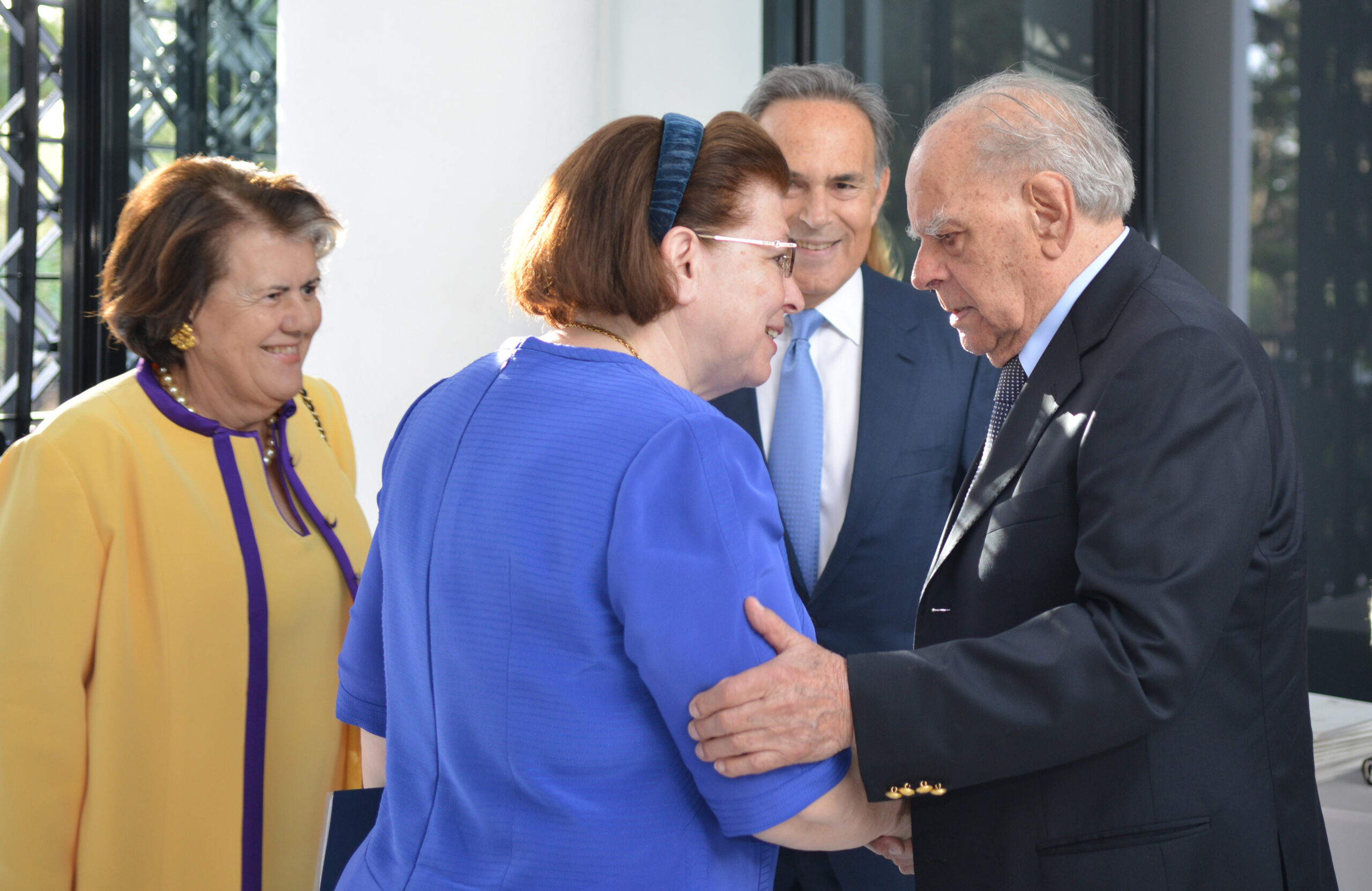
Dedicated to Konstantinos Karamanlis’ major contribution to culture and his enduring cultural legacy, the event entitled “Culture and Democracy” was held on the evening of Wednesday, 22 May 2024 at the Konstantinos G. Karamanlis Foundation, in the presence of leading figures from the arts and letters.
The event was organized on the occasion of the 50th anniversary of the restoration of democracy in Greece, in cooperation with the European Cultural Centre of Delphi.
The event began with a speech by the Minister of Culture, Lina Mendoni, who spoke at length about Constantinos Karamanlis’ vision and work in the field of culture.
Distinguished figures from the world of culture, such as Nikolaos Stampolidis (Director of the Acropolis Museum), Olga Mentzafou (President of the National Gallery), Panagiotis Tournikiotis (Professor of Architecture, National Technical University of Athens), Kyriakos Koutsomallis (General Director of the Basil and Elise Goulandris Foundation), Christophoros Charalambakis (Member of the Academy of Athens and Emeritus Professor of Linguistics, University of Athens), Chrysi Karydi (Ikaros Publishing House), and composer Dimitris Papadimitriou, highlighted both well-known and lesser-known aspects of Karamanlis’ cultural policies.
Karamanlis introduced major institutional reforms in the cultural sector, creating the conditions that enabled modern Greece and its cultural community to develop their creative potential beyond their illustrious past and to claim a rightful place among contemporary nations.
Initiatives such as the Athens and Epidaurus Festival, the state theatres, the renewal of the National Opera, the National Gallery, the European Cultural Centre of Delphi, the Hellenic Foundation for Culture, and the Third Programme of Greek Radio under Manos Hadjidakis constituted milestones of Karamanlis’ cultural policy.
At the same time, Karamanlis supported both the humanities and the natural sciences through the establishment of institutions such as the Institute of Byzantine and Post-Byzantine Studies in Venice, the National Hellenic Research Foundation, and the Demokritos National Research Center.
Karamanlis also mobilized the state apparatus for the development of the Acropolis surroundings and the support of major archaeological excavations in Macedonia (Vergina, Dion, Pella), recognizing their national importance. He provided moral and material support to leading archaeologists, including Manolis Andronikos, Dimitris Pantermalis, and Giorgos Mylonas, enabling the implementation of an extensive archaeological programme across Greece.
Equally significant was the institutional recognition of Modern Greek as the official language of the state, bringing an end to the long-standing “language question.”
During both his terms in office, Karamanlis pursued a coherent and comprehensive cultural strategy, firmly believing that nations are primarily inscribed in history through their cultural achievements.
Supported by leading figures of Greece’s intellectual and artistic world, beyond the boundaries of his own political camp, Karamanlis left behind a substantial and enduring cultural legacy.
Reference was also made to his close relationships with some of the most distinguished cultural figures of his time, including Trypanis, Tsatsos, Horn, Hadjidakis, Anna Synodinou, Karolos Koun, and Odysseas Elytis.
The event was addressed by Achilleas Karamanlis, President of the Foundation, and Panagiotis Roilos, President of the European Cultural Centre of Delphi. The discussion was moderated by Konstantinos Arvanitopoulos, General Director of the Foundation and Professor of International Politics.
Event: Culture and Democracy
09 May 2024